


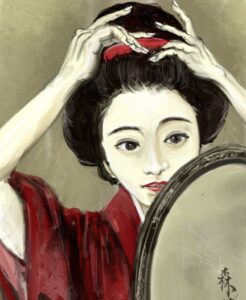
A comb. That alone — a morning ritual.
What is the woman standing before the mirror looking at?
Her own figure, or something that cannot be reflected?
This time, I’ll look back at the making of “Kushi,” a new work in my Taisho Roman series.
The making of the bijinga “Longing” is here
Previously: introducing “A New Tale of the White Rabbit of Inaba” (in Japanese)
How “Kushi” Was Born
This work had a source of inspiration: “Woman Combing Her Hair” (1920) by Hashiguchi Goyo, a printmaker active from the Taisho into the Showa era. Its composition is so dynamic and delicate at once that I ran my Apple Pencil through much trial and error, wondering whether I could really bring it together in my own way.
But there was one thing I had decided clearly before I even began drawing.
It was to draw not “a woman fixing her hair,” but “a woman facing the mirror.”
And to express her delicate “hands.”
How much of a woman’s inner world, her beauty, and her allure can be made to dwell in her hands — that was the greatest challenge this time.

The Choice of Red — Comb, Kimono, Lipstick
There are three “reds” in this picture.
A red comb, a red kimono, and red lipstick. All of them use the same red.
Translucent white skin, glossy black hair, and a golden-brown background. Into that, I scattered red as if placing dots.
The fewer the colors, the more strongly the contrast appeals to the eye. I paint believing that.
What Hands Tell
When you look at this work, where do your eyes go first?
I think for many people, it isn’t the face — it’s the “hands.”
The bony joints of the fingers, the smoothly extended nails, and the exact measure of force as they slip into the hair. This is where I put my soul.
A “face” tells the expression of that moment. But “hands” have the power to tell the very life that person has walked. That’s what I believe.

What Does the Mirror Reflect?
The mirror drawn in this work shows only its back.
A mirror reflects not a person’s figure, but their heart.
With that intention, I deliberately did not paint the mirror’s surface.

The Golden-Brown Background and Texture
The work is made entirely digitally, and the layers are just four: “rough, line art, coloring, background texture.”
The golden-brown background — that texture like old washi paper — is built up on its own single layer. Its hazy, bleeding unevenness is the key… but the method is still a trade secret. (laughs)
Using new digital tools while deliberately expressing an analog “passage of time” and “old air” — that is also a theme running through all of my work.

Until the Title Became “Kushi”
Deciding the title actually took some worrying.
I had several candidates — “Totonou (In Order),” “Combing Her Hair,” “Before the Mirror” — but even asking AI didn’t click. In the end, I arrived at the single kanji “櫛.”
I felt that this one character could tell everything about this picture.
For overseas, I use “Kushi.”
Even if you don’t know the meaning of the word, I believe its very sound conveys something.
The Finished Work and Where to Buy
The new work “Kushi” is on sale at INPRNT, an overseas art print service.
You can order it as a fine art print, from A4 up to large sizes.
If you like this world of mine, please take a look at the gallery.
→ See the INPRNT gallery “morirancru”

For the next work, too, I’d like to keep leaving the process behind in this way.
Thank you for reading to the end.
Continued: introducing Amaterasu, “Amaterasu Omikami” (in Japanese)
The making of a bijinga with just 3 layers is here (summary)


Comments