

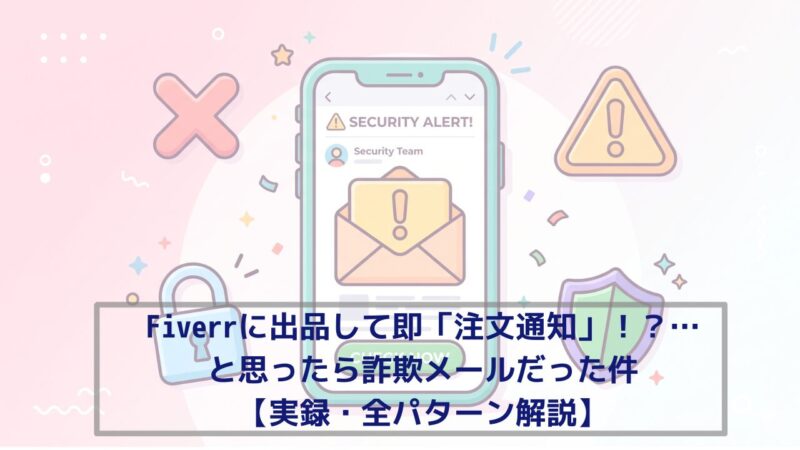

Right after I registered on Fiverr and published my gig (my service listing) —
an “order notification” suddenly arrived, and my heart leapt.
“Yes! Finally, a request from overseas!”
…But reality wasn’t so sweet.
What had arrived was a cleverly crafted “scam message.”
As I kept my listings up, similar messages started arriving from time to time. At first I genuinely panicked, but now I can spot them at a glance — “ah, this pattern again.”
This time, I’m publishing the patterns of scam messages I actually received, all in one place.
I hope it helps anyone about to take on overseas markets avoid the same anxiety and trouble.
Previous: How I Created My Fiverr Gig
⚠️ The 4 “Scam Message” Patterns I Encountered
Pattern 1: They try to lure you to an outside SNS
“I’m interested in your work. Let’s talk details on WhatsApp.”
This is the most common pattern.
Once you’re lured outside Fiverr, you lose all of the platform’s protection (payment guarantees, dispute support, and so on). Worse, responding to an invitation to communicate externally is itself a violation of the terms — your own account could be at risk of suspension. No matter how attractive the offer looks, never respond.
Pattern 2: They send suspicious links or QR codes
“I’ve put the materials together here. Please check: [URL]”
While naturally steering the conversation toward “please send me your work,” they send a URL or QR code. The destination may be a phishing scam designed to steal personal or account information. “Never open unknown URLs” — this really is an iron rule.
Pattern 3: They pressure you with an abnormal sense of urgency — “Right now!”
“It’s an urgent job. Please reply within today.”
Real clients also have urgent jobs, but excessive pressure from a complete stranger is a warning sign. Rushing you so you can’t think calmly is a classic scam technique.
Precisely when someone says “it’s urgent, respond immediately,” stop and check their profile first.
Pattern 4: Unnaturally “over-polite Japanese”
“Dear Sir/Madam, I was deeply moved by your talent…”
They’re supposedly a foreigner, yet the Japanese is strangely fluent and old-fashioned. And it’s nothing but compliments unrelated to what my service actually offers. These are often mass-sent using translation tools, and that “something feels off” sensation is a surprisingly important clue.
🔍 3 Checkpoints for Spotting Them
If a suspicious message arrives, check these three points.
- Are they trying to lure you outside Fiverr?
- Does it contain a URL or file you don’t recognize?
- Is the account name a random string like “user12345”?
If even one applies, don’t reply — just report it as “Spam.”
Why I Still Continue with Fiverr
Honestly, at first I was quite down about it.
When the only responses to a gig you worked hard on are scams, you start thinking negatively — “maybe my work just isn’t appealing…”
But partway through, I changed how I think about it.
“The scams are coming” means my gig is at least appearing in search results and catching someone’s eye.
Of course scams are a nuisance, but when you dive into a new market, going through this kind of “initiation” at first isn’t unusual.
Until the day I meet a real, wonderful client.
I intend to keep taking on the challenge of overseas markets.
Next: My INPRNT Registration and Approval Story
The big comparison of 5 overseas platforms is here
Summary
- Fiverr scams follow a fairly fixed set of patterns
- For lures to external links or contact methods, “ignore” is the iron rule
- There’s a positive side too: “scams arriving = your page is being seen”
Taking on overseas markets comes with anxiety, but it’s also true that beyond it lie chances and connections you’d never meet in Japan.
Let’s move forward step by step — without rushing, and enjoying the process!
Next time, I plan to write about the improvements I actually tried to grow my gig’s traffic. Stay tuned!

Comments