

One day, a notification like this arrived from Redbubble.
“Congratulations, you have been certified as a Premium seller”
For a moment, I thought, “Has something finally started moving?”
But, to give the conclusion first: Premium certification ≠ increased sales.
This time, I’ll write about how that unfolded.
Previous: How to list products on Zazzle and the image trap, is here
What you’ll learn in this article
- What specifically changes — and what doesn’t — when you receive Redbubble’s “Premium seller” certification
- Why sales stayed at ¥0 even after certification
- What number of listings Redbubble officially recommends
- What easy-to-make mistakes I found while reviewing the tags of 24 works
- What I’m going to try next
The Story of My Redbubble Shop So Far
My Redbubble shop was opened to the public on July 3, 2026.
Until then, for about two months, my PayPal (morirancru@gmail.com) registration and linking had been missed, so although my products were registered, I was effectively unable to sell.
Once I found the cause and linked PayPal, 16 designs finally went out into the world.
A little over two months since then.
The number of designs has grown, and it’s gradually come to look like a shop.
It was amid all that, that the Premium certification notice at the beginning arrived.
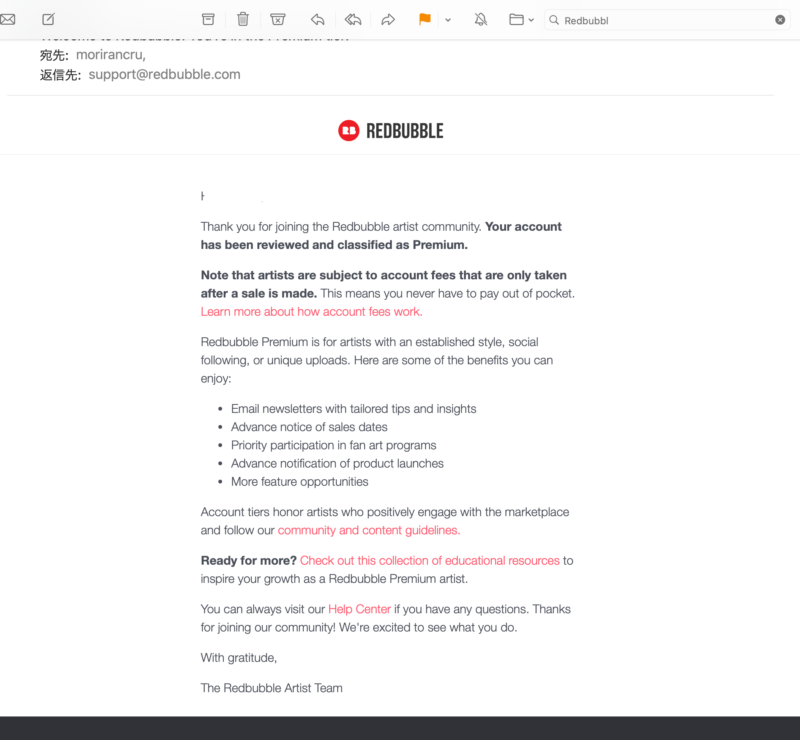
The Premium certification email that actually arrived
What Is “Premium”?
Redbubble’s account tiers and fees
*Fees apply only when a sale occurs (a percentage of monthly earnings)
This certification
No fee
Premium = not “a magic badge that makes you sell more,”
but “a tier with a lighter fee burden”
Looking into it, Redbubble has three account tiers: Standard, Premium, and Pro.
Premium is aimed at artists and the like who have a personal brand or an existing follower base and create original works.
However, here I had one big misunderstanding.
Becoming Premium does not mean the fees become free.
In other words, Premium is an account tier where the fee burden is lighter than Standard.
That said, there are extra benefits too, so it’s not that it’s “meaningless.”
Still, the expectation I had the moment I saw the notice —
“Maybe this will increase how often my works get seen!”
— seems to have been a little off (lol).
And Still, Sales Were ¥0
Even after some time had passed since the Premium certification.
The result was —
Zero sales.
As expected, it doesn’t go that easily (lol).
This is a little similar to when 1,658 FAA visitors still brought no sales.
“Being seen” and “being bought” seem to be separate problems.
As I continue my overseas side business, I run into this wall again and again.
Why Don’t “Certification” and “Sales” Connect?
Using this Premium certification as a trigger, I thought it over again.
After that, another email from Redbubble, “The Roadmap to Your First Sale,” had the officially recommended guidelines written in it.
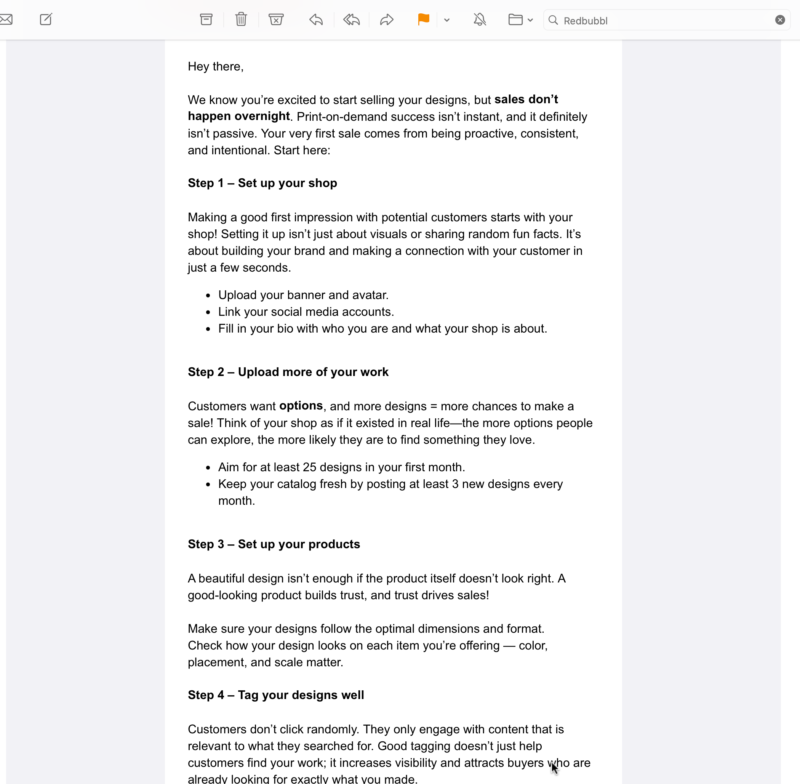
The “Roadmap to Your First Sale” email that arrived from Redbubble
- Have at least 25 designs ready in your first month
- After that, add at least 3 new designs every month and keep your catalog “fresh”
In other words, apart from the “evaluation” of Premium certification, my number of listings itself hadn’t reached the guideline in the first place. Before fixing tags and descriptions, maybe I hadn’t even reached the starting line in terms of quantity.
“Certification” and “sales” are separate stories
Creators from all over the world are listing, so
for a fledgling shop, getting a flood of orders just by “becoming Premium” is difficult
I Actually Reviewed the Tags
I checked the actual numbers on the dashboard again.
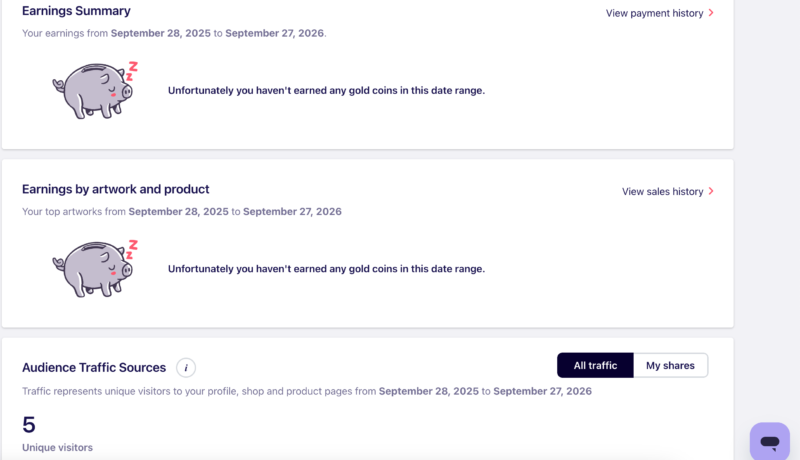
Earnings and visitors over about 3 months (from the Redbubble dashboard)
Over this roughly half year (May to September 27, 2026), earnings were ¥0. Unique visitors were just 5 😢.
It wasn’t a vague sense of “zero sales” — the measurements clearly showed it.
Honestly, I still have no conviction that “do this and it will sell.”
But I decided to stop just waiting blindly, and set about reviewing the titles and tags of all 24 works.
The first thing I noticed when I tried was that I had misunderstood the mechanism itself.
I had thought “tags are 15 words you enter freely all together,” but in fact they were structured as a split between “Main Tag (1 = the keyword you most want to be searched by)” and “Supporting Tags (14 = related words that supplement it).”
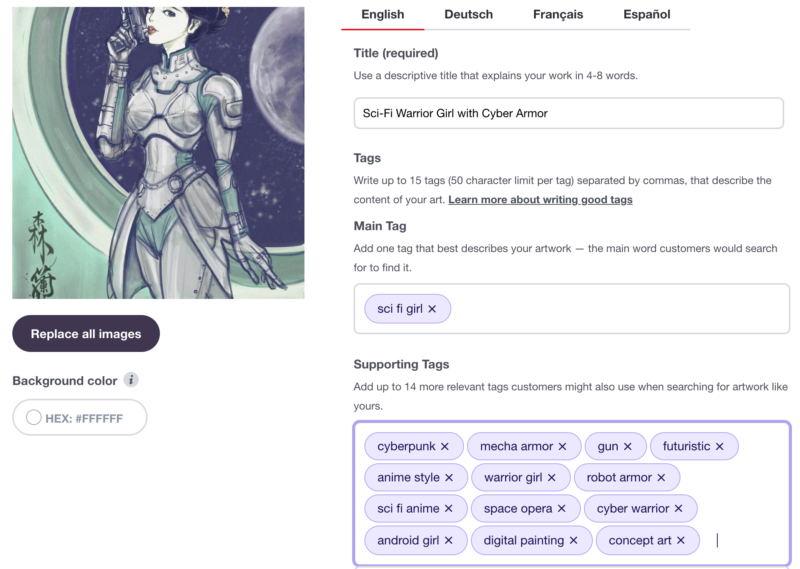
Decide “the one word I most want this work to be searched by” first, then build the rest. I learned that this order makes more sense.
Furthermore, during the review I found three pitfalls.
Discrepancies I never noticed while drawing were found in the humble work of tagging. That, too, was one of this time’s discoveries.
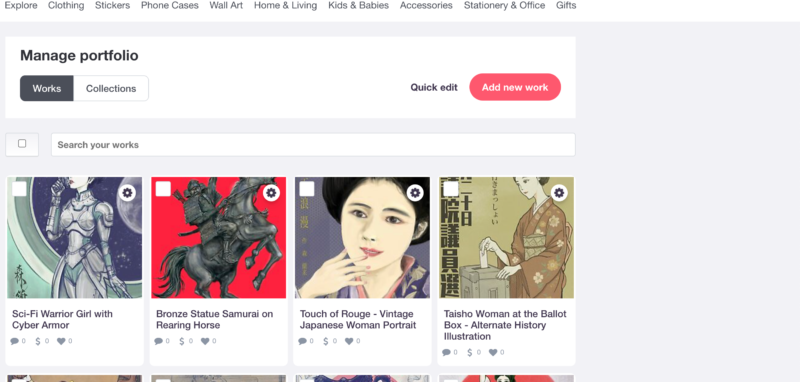
The title list after review (from Redbubble Manage portfolio)
The full prompt I used to mass-produce tags and descriptions is here (in Japanese)
What I’ll Do Next
What happened when I actually changed these things. Or what didn’t happen (lol).
Next time, I’ll report the results.
Three things to try next
Continue the tag review, and add more listings
Review the remaining works with the same procedure. Also keep Redbubble’s recommendation of “at least 3 new additions every month” in mind
Expand product types
Expand beyond posters to easy-to-pick-up products like stickers and phone cases
Inflows from outside (Pinterest)
My SNS followers are mostly Japanese, and there’s a limit to direct guidance to Redbubble. I’ll try Pinterest, where the works themselves can be seen without relying on English ability
Continued: Overseas access to my blog and the identity of the bots, is her
The five overseas platform comparison roundup is here
Summary
Summary of this article
Being certified ≠ your works selling. Premium has the merit of a lower fee rate, but it wasn’t magic that makes you sell more easily
The measurements: earnings ¥0, visitors 5. The tag review found misaligned tags, romanized titles, and discrepancies with historical facts
Next, I’ll actually change the number of listings, product types, and inflow routes
Will it lead to sales?
My overseas side business is still very much an experiment in progress.


Comments